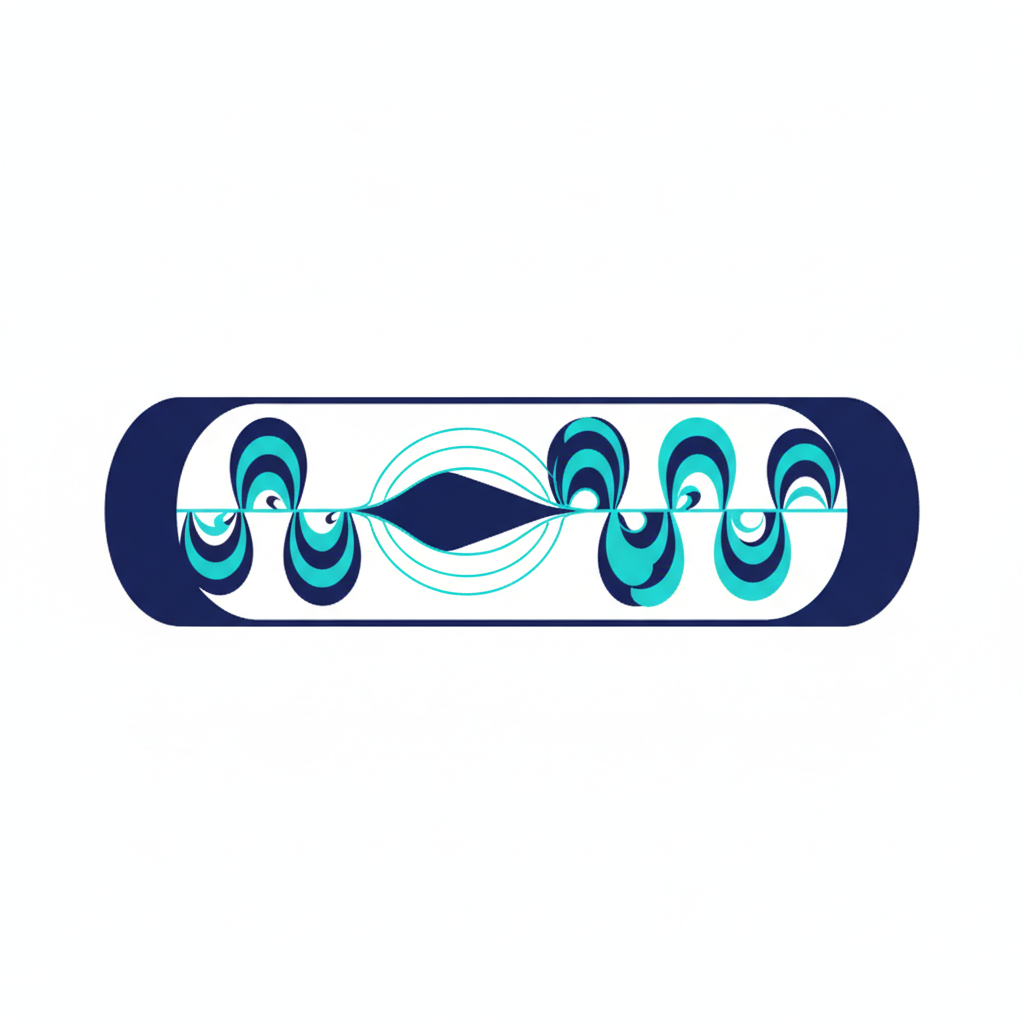
Vortex flow meters operate on the von Karman vortex shedding principle. When fluid flows past a bluff body (called a shedder bar) placed in the flow stream, alternating low-pressure vortices form on each side of the bar and detach downstream in a repeating pattern.
The frequency of these vortices is directly proportional to the flow velocity. A piezoelectric or capacitive sensor embedded in or immediately behind the shedder bar detects each vortex as a pressure fluctuation. The meter electronics convert this frequency into a calibrated flow rate.
1
Fluid Enters the Meter
Steam, gas, or liquid flows through the meter body and encounters the shedder bar.
2
Vortices Form
Alternating vortices shed from each side of the bar at a frequency proportional to velocity.
3
Sensor Detects the Signal
A piezoelectric sensor converts each vortex into an electrical pulse with high signal-to-noise ratio.
4
Electronics Calculate Flow
The transmitter converts pulse frequency to volumetric or mass flow rate using the K-factor.
Product Range
Types of Vortex Flow Meters
Different installation requirements call for different meter configurations. Select the type that matches your pipe size, process conditions, and accuracy needs.
Inline Vortex Meters
Installed directly in the pipeline for full-bore flow measurement. Best for permanent installations where maximum accuracy is required across the full flow range.
Sizes
DN15 to DN300 (0.5" to 12")
Accuracy
+/- 0.75% of reading
Insertion Vortex Meters
Probe-style design inserted through a single pipe penetration. Ideal for large diameter pipes where inline meters would be prohibitively expensive or impractical to install.
Sizes
DN100 to DN3000 (4" to 120")
Accuracy
+/- 1.5% of reading
Multivariable Vortex Meters
Measure flow rate, temperature, and pressure simultaneously in a single device. Built-in flow computer calculates mass flow and energy output, eliminating the need for separate transmitters.
Sizes
DN15 to DN300 (0.5" to 12")
Accuracy
+/- 1.0% of mass flow
Sanitary / Hygienic Meters
Designed with tri-clamp connections and electropolished wetted surfaces for food, beverage, and pharmaceutical applications. Meet 3-A sanitary standards and FDA requirements.
Sizes
DN15 to DN100 (0.5" to 4")
Accuracy
+/- 1.0% of reading
Built for the Toughest Environments
From cryogenic LNG to superheated steam at 430 C, vortex meters deliver consistent, reliable measurement where other technologies fall short.
Applications
What Vortex Meters Measure
One technology platform covers the three major flow measurement categories: steam, gas, and liquid.
Steam Measurement
Vortex meters are the preferred technology for saturated and superheated steam measurement. Multivariable models calculate mass flow and energy directly, enabling accurate steam accounting and energy management across boiler plants and distribution systems.
Natural Gas & Biogas
Wide turndown ratios and no pressure drop penalties make vortex meters ideal for custody transfer, burner control, and allocation metering in natural gas distribution. They handle fluctuating flows common in biogas applications without recalibration.
Liquid Flow
Measure water, chemicals, solvents, and other clean liquids with high accuracy and repeatability. The absence of moving parts means no wear-related drift, even in continuous 24/7 process applications.
Industries
Industries We Serve
Vortex flow meters are trusted across the world's most demanding process industries, from offshore platforms to pharmaceutical cleanrooms.
Oil & Gas
Custody transfer, flare gas, fuel gas metering, and process optimization across upstream, midstream, and downstream operations.
Chemical Processing
Reactor feed measurement, solvent recovery, and utility monitoring in corrosive and high-temperature environments.
HVAC & Building Systems
Chilled water, hot water, and steam metering for energy management, submetering, and building automation integration.
Power Generation
Boiler feedwater, steam distribution, cooling water, and turbine efficiency monitoring in thermal and combined-cycle plants.
Food & Beverage
Sanitary flow measurement for CIP systems, ingredient dosing, and utility tracking with FDA-compliant materials.
Pharmaceutical
Clean steam validation, WFI distribution, and process fluid measurement under GMP and 21 CFR Part 11 requirements.
Why Vortex
Key Advantages
Vortex technology delivers unique benefits that reduce total cost of ownership while improving measurement reliability.
10+ yearstypical service life
No Moving Parts
The shedder bar is the only element in the flow stream. No bearings, gears, or rotors to wear out, corrode, or foul. This translates to years of maintenance-free operation.
20:1turndown ratio
Wide Turndown Ratio
Accurately measure flows from trickle to torrent. Vortex meters typically deliver 20:1 or better turndown, handling the full range of operating conditions without switching instruments.
Near Zeroannual maintenance
Low Maintenance Cost
No consumable parts, no periodic recalibration under stable conditions, and no moving components to replace. Total cost of ownership is significantly lower than differential pressure or turbine meters.
3-in-1steam, gas, liquid
Multi-Fluid Versatility
A single vortex meter technology handles steam, gas, and liquid measurement. Reduces spare parts inventory and simplifies operator training across your facility.
+/- 0.75%of reading (liquid)
High Accuracy
Precision-machined shedder bars produce stable, well-defined vortex signals. Factory calibration on NIST-traceable flow rigs ensures accuracy from day one.
430 Cmax temperature
Extreme Conditions
Rated for process temperatures up to 430 C (800 F) and pressures to 250 bar (3,625 psi). Handles the demanding conditions found in power plants, refineries, and chemical facilities.
Technology
Digital Integration
Modern vortex meters come equipped with HART, Foundation Fieldbus, PROFIBUS, Modbus, and wireless protocols. They integrate directly into your DCS, PLC, or SCADA system for real-time monitoring and diagnostics.
4-20 mA + HART 7
Foundation Fieldbus H1
WirelessHART / ISA100.11a
Modbus RTU & TCP/IP
Built-in diagnostics & alerts
Questions
Frequently Asked Questions
Common questions about vortex flow meter selection, installation, and operation.
How does a vortex flow meter work?
A vortex flow meter works on the principle of vortex shedding, first described by Theodore von Karman. A bluff body (shedder bar) is placed in the flow stream, which causes alternating vortices to form downstream. The frequency of these vortices is directly proportional to the flow velocity. A piezoelectric sensor detects each vortex as a pressure fluctuation, and the electronics convert the frequency into a volumetric or mass flow rate.
What fluids can vortex flow meters measure?
Vortex flow meters measure clean liquids, gases, and steam. Common applications include water, natural gas, compressed air, nitrogen, steam (saturated and superheated), solvents, and light hydrocarbons. They are not recommended for very viscous fluids (above approximately 30 cSt), slurries, or fluids with high concentrations of solids, as these can dampen or distort the vortex signal.
What is the typical accuracy of a vortex flow meter?
Inline vortex flow meters typically achieve +/- 0.75% to 1.0% of reading for liquids and +/- 1.0% to 1.5% of reading for gases and steam. Insertion models are generally +/- 1.5% to 2.0% of reading. These figures apply within the meter's specified Reynolds number range and with proper upstream/downstream straight run.
How much straight pipe run do vortex meters need?
Most manufacturers recommend 15 to 20 pipe diameters of straight run upstream and 5 pipe diameters downstream for standard installations. Certain upstream disturbances (double elbows out of plane, control valves) may require 30 or more diameters. Flow conditioners can reduce these requirements to 10 diameters upstream in constrained installations.
Can vortex meters measure steam energy (BTU/kWh)?
Yes. Multivariable vortex meters measure flow, temperature, and pressure simultaneously, allowing the built-in flow computer to calculate mass flow rate and energy (in BTU, kWh, or GJ) in real time. This makes them the preferred choice for steam energy management, boiler efficiency monitoring, and sub-metering for cost allocation.
What is the lifespan of a vortex flow meter?
With no moving parts to wear out, vortex flow meters routinely operate for 10 to 20 years or more without significant degradation. The shedder bar and meter body are typically machined from 316 stainless steel or other corrosion-resistant alloys. The piezoelectric sensor is hermetically sealed. Periodic verification against a reference is recommended, but routine recalibration is seldom needed.
How do vortex meters compare to other flow technologies?
Compared to differential pressure (orifice plate) meters, vortex meters offer wider turndown (20:1 vs 4:1), lower permanent pressure loss, and no impulse lines to maintain. Compared to Coriolis meters, vortex meters are lower cost and available in larger sizes, but Coriolis offers higher accuracy for mass flow. Compared to magnetic flow meters, vortex meters work on gases and steam (mag meters only measure conductive liquids). Compared to turbine meters, vortex meters have no moving parts, eliminating bearing wear.
What outputs and protocols do vortex meters support?
Modern vortex flow meters support 4-20 mA analog output with HART communication as standard. Many models also offer Foundation Fieldbus, PROFIBUS PA, Modbus RTU/TCP, and wireless (WirelessHART or ISA100.11a). Pulse and frequency outputs are available for totalizing and batch applications. Most can be configured via local display, handheld communicator, or asset management software.
Get Started
Request a Consultation
Tell us about your flow measurement application and our specialists will recommend the right vortex meter configuration for your process conditions, pipe size, and budget.
Application Engineering
Our engineers will review your process data and recommend the optimal meter size, type, and configuration.
Fast Response
We respond to all inquiries within one business day with detailed sizing recommendations and pricing.
Quality Guaranteed
Every meter is factory-calibrated on NIST-traceable flow rigs and ships with a certificate of conformance.